CAT-5 cable
Category 5 cable for Ethernet, or CAT-5 cable
- Unshielded twisted pair cable or UTP cable
- RJ-45 connector on either end

If you open up a CAT-5 cable, you’ll find eight colored wires twisted into four pairs. One pair is brown, another pair is blue, another pair is green, and the final pair is orange. Each pair consists of one plain and one striped wire.
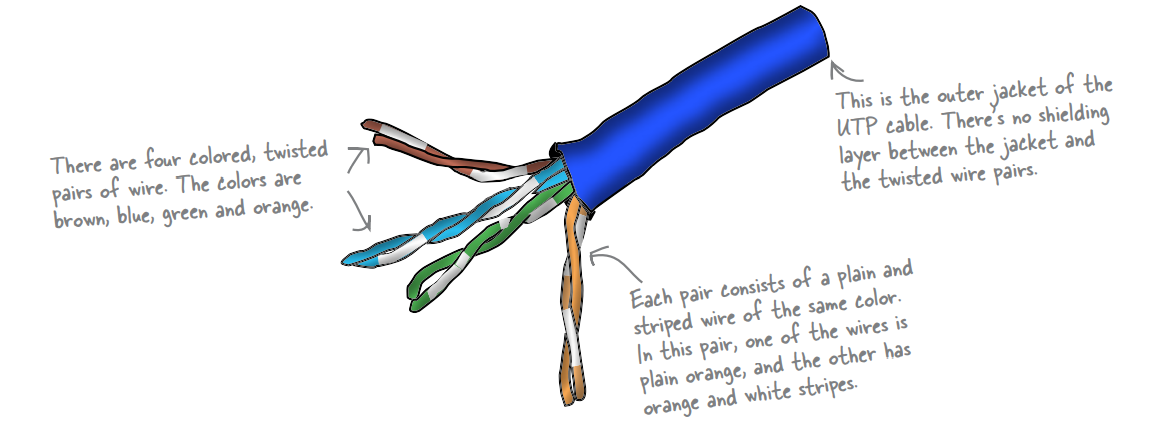
So why are the pairs twisted?
The problem with wires that aren’t twisted is that they generate magnetic fields that interfere with the signal carried on the wire. This means that you can get electromagnetic interference and crosstalk— both of which are bad for your network data.
What’s with all the colors?

Orange and green wires send and receive data. The orange pair sends data, while the green pair receives data.
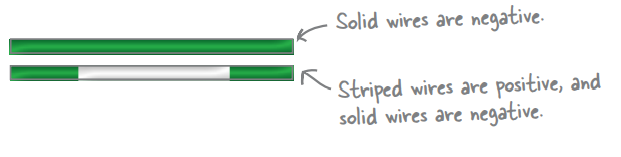
The color solidity shows the wire polarity. If a wire is striped, then this means that it is positive. If a wire is solid, then the wire is negative.
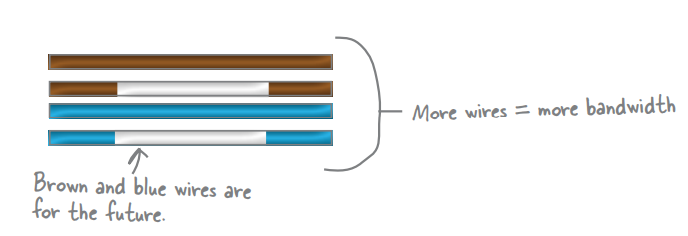
Blue and brown wires are reserved for future bandwidth capacity.
What’s the difference between megabits per second (Mbps) and megabytes per second (MBps)?
Megabits per second (Mbps) is a bandwidth rate used in the telecommunications and computer networking field. One megabit equals one million bursts of electrical current (aka binary pulses).
Megabytes per second (MBps) is a data transfer rate used in computing. One megabyte equals 1, 048, 576 bytes, and one byte equals 8 binary digits (aka bits).
What is Base-T?
The 10 Base-T standard transfers data at 10 megabits per second (Mbps). The 100 Base-T standard transfers data at 100 Mbps.
The order of the wires in an RJ-45 connector conforms to one of two standards. These standards are 568A and 568B.
568A wire order
Striped green, solid green, striped orange, solid blue, striped blue, solid orange, striped brown, solid brown.

568B wire order
Striped orange, solid orange, striped green, solid blue, striped blue, solid green, striped brown, solid brown.


Crimping Tool

Crossover Cable
A crossover cable is different from a straight-through cable in that a straight-through cable can only send or receive data on one end at a time.
The maximum length of CAT-5 is 328 feet (100 meters).