Packets

- Manchester Phase Encoding
- Non-Return to Zero
Network cards handle encoding
It handles and decodes digital signals
Media Access Control (MAC) address. The MAC address is a unique identifier for the NIC used in any data sent over a network.
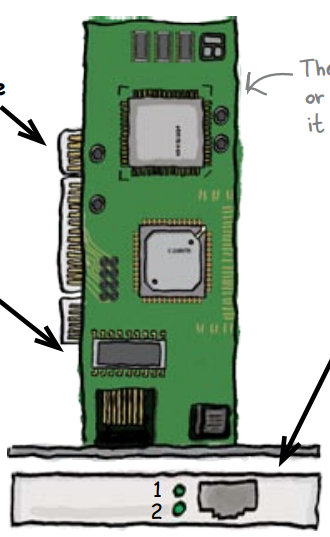
The NIC produces the voltage necessary to push the signal across the network.
Lights next to the port tell you the NIC is connected to the network (1), and the NIC is sending data on the network (2).
how does the NIC encode the data?
NIC starts by taking the message that needs to be sent across the network
then turns the message into binary numbers, a series of 0’s and 1’s
it encodes these numbers, and sends corresponding voltage signals through an attached network cable.
Ethernet standard tells hardware how to encode the data
Manchester phase encoding. So if the signal is sent using the Ethernet protocol, it uses Manchester encoding.
The protocol for 10BaseT Ethernet specifies that the signal will be encoded using Manchester encoding.
The signal is sent through the Ethernet cable
Inside the NIC, NRZ encoded data is combined with a clock signal to create a Manchester encoded signal.
In NRZ encoding, the binary data is represented by the high and low voltage levels; high is a 1, low is a 0. In Manchester encoding, it is the TRANSITION to a voltage that represents data.
Inside the NIC, the received Manchester encoded signal is converted in to NRZ. The NIC then lets the CPU know it has data.
Data encoding comes in many flavors: American Standard Code for Information Interchange (ASCII), Binary Coded Decimal (BCD), Differential Manchester Encoding (DME), Extended Binary Coded Decimal Interchange Code (EBCDIC), Feedback Shift Register (FSR), Manchester Phase Encoding (MPE), Non Return to Zero (NRZ), Non Return to Zero Invertive (NRZ-I), Return to Zero (RZ), and Unicode.
Manchester, NRZ, and NRZ-I.
Older schemes? What is being used now in networking?
A: 4B/5B and 8B/10B are used for Fast Ethernet and Gigabit Ethernet. The 4B/5B scheme uses 5 bits to represent the 4 bit numbers and 10 bits to represent 8 bit numbers. This is done to assure that there is a transition at some point.
Unicode.
It allows for millions of characters.
So do all speeds of Ethernet use Manchester Encoding?
A: Good Question. No, they don’t. 100 Mbps, or Fast Ethernet, uses the 4B5B encoding scheme. The simplest way to think about this encoding scheme is that 5 bits are used to transmit 4 bits of data. Gigabit Ethernet, 1000Mbps or 1Gbps, uses and 8B10B encoding scheme. Gigabit Ethernet also uses all 4 pairs of wire in a cable.
A signal with the clock embedded in the signal allows the receiver to properly decode the signal because the data is in the transitions of voltages and not in just the voltage level.
Protocols define the structure of a message
In order to effectively communicate, network devices use protocols, a set of guidelines, or rules, for the network conversation. These procotols cover such things as how fast data can be sent and how data will be structured when it’s sent.
Network messages come in two kinds of packages: frames and packets.

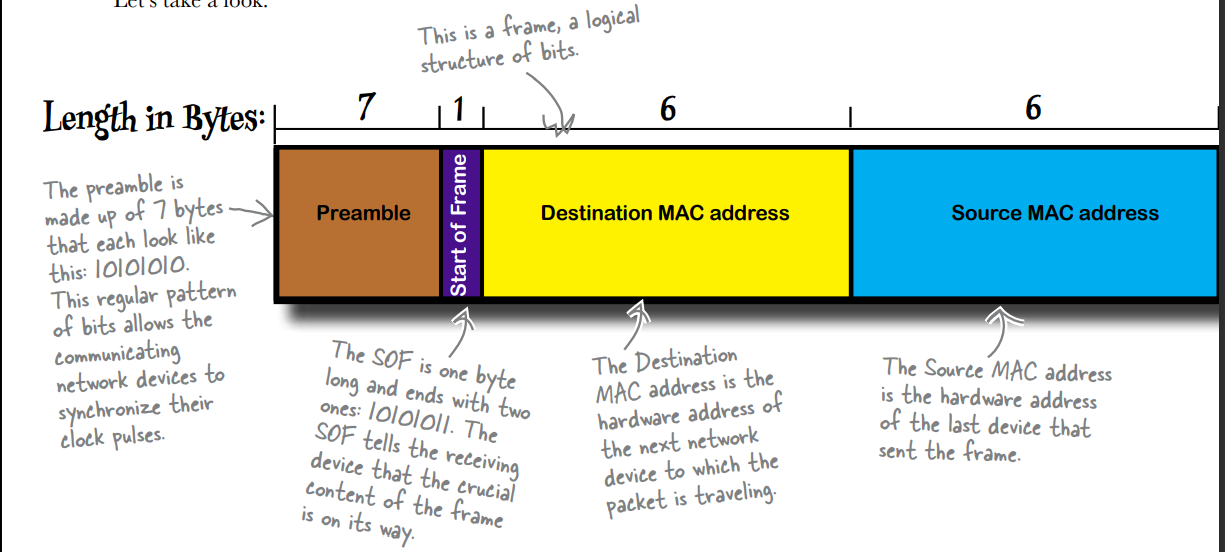
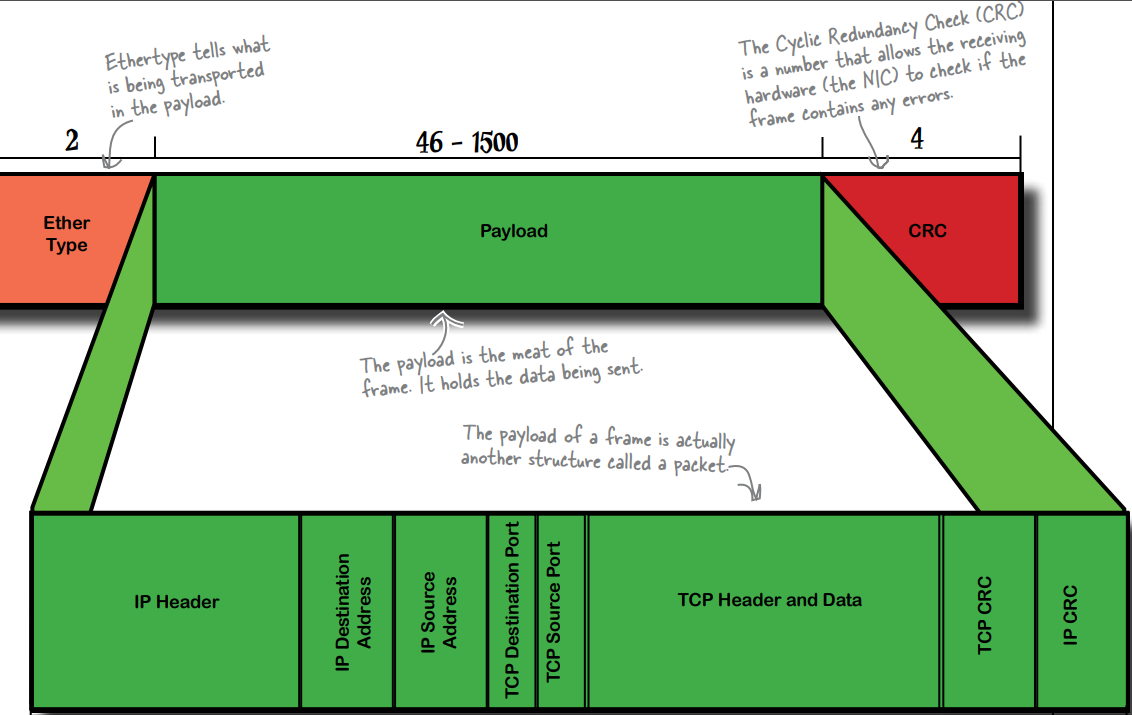
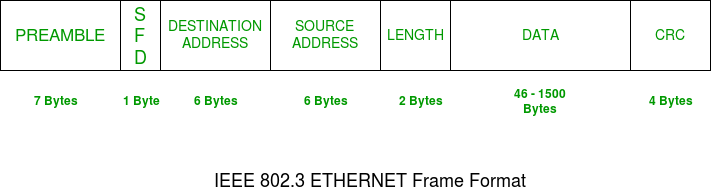
Ethernet (IEEE 802.3) Frame Format –
Can I change my MAC address?
A: The company that manufactured the NIC in your computer burned it into a ROM chip on your NIC. Unless you’re an electrical engineer with access to ROM burning equipment, it will be pretty hard to change the MAC address. You can, however, fake out others on the network by “spoofing” your MAC address. Typically this requires a software utility. We don’t recommend MAC address spoofing because many companies regard it as a security violation and it could result in legal action.
Are MAC addresses just random numbers or do they mean something?
The first half of the MAC address is a special code assigned to the manufacturer of the hardware; the last half of the address is a number the manufacturer uses to number the devices they produce
Is someone in charge of giving out MAC addresses?
The Institute of Electrical and Electronics Engineers Registration Authority is in charge of issuing MAC addresses.
Will we ever run out of MAC addresses?
There are 248 or 281,474,976,710,656 possible MAC addresses. The IEEE does not expect to exhaust the address space until 2100. I guess we’ll worry about it in 2099.